
A new multisociety position paper convened by the Infectious Diseases Society of America (IDSA) is broadening the conversation about what it takes to improve sepsis outcomes.
Published August 25 in Clinical Infectious Diseases, the paper was developed by a 24-member multidisciplinary panel that included representatives from eight other professional societies and the Sepsis Alliance. Its central message is significant: improving sepsis outcomes requires coordinated strategies that extend beyond early recognition and initial treatment.
For hospital sepsis programs, that raises an important operational question.
How do you reliably execute a broader and more interconnected set of sepsis recommendations, protocols, and care processes without adding more burden to the clinical teams responsible for delivering them?
Sepsis improvement is expanding beyond the initial bundle
Early recognition and timely treatment remain foundational to sepsis care.
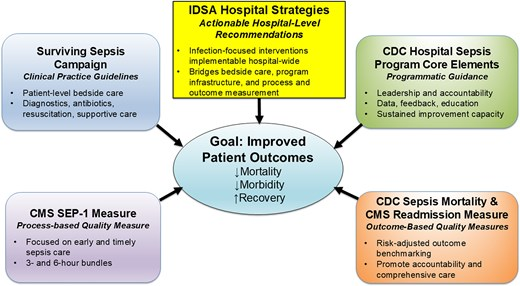
But the IDSA-led position paper takes a broader view. Its recommendations span six domains: diagnostic testing and pathogen detection, antimicrobial management and delivery, surveillance and performance metrics, adjunctive therapy, program infrastructure and organizational support, and infection prevention.
Importantly, the paper is not simply a new list of bedside recommendations. It focuses on the hospital-level systems, workflows, measurement, and infrastructure needed to make evidence-based sepsis care happen consistently.
The paper discusses hospital workflows and performance monitoring for timely antibiotic administration, clinical decision support, EHR-based surveillance, antimicrobial de-escalation, source-control measurement, and multidisciplinary sepsis governance, among other strategies.
None of these practices exists in isolation.
Together, they require hospitals to coordinate clinical decisions, workflows, data, measurement, reassessment, and accountability across a patient’s care journey.
The challenge is no longer simply whether a hospital has a sepsis protocol.
The challenge is whether the organization can execute that protocol consistently as the patient’s condition, care setting, and available clinical information change.
More sophisticated care cannot mean more cognitive burden
The natural response to additional clinical guidance can be to add another protocol, another notification, another dashboard, or another manual review.
That approach has limits.
Sepsis is already managed across emergency departments, inpatient units, ICUs, nursing teams, physicians, pharmacy, laboratory services, quality teams, and other disciplines. Patients move between units. Clinical information changes. New test results arrive. Treatments need to be initiated, reassessed, adjusted, and documented.
The new position paper reinforces how many of those activities need to be viewed as part of a connected sepsis program rather than separate events.
For clinicians, the goal should not be remembering more steps.
The supporting infrastructure should make those steps easier to carry through.
Surveillance is becoming a larger part of the sepsis strategy
One of the most relevant themes in the paper is the emphasis on surveillance and performance measurement.
The panel recommends the CDC Adult Sepsis Event definition as an approach for monitoring sepsis incidence, outcomes, and care processes. It also recommends measuring areas such as inadequate and unnecessarily broad empiric antibiotic therapy, antimicrobial de-escalation, and time to definitive source control.
The role of surveillance is expanding beyond identifying a patient who may have sepsis.
Hospitals increasingly need visibility into what happens after recognition.
That creates a related operational question: how do teams translate what they measure at the program level into better visibility during the patient’s care?
Was the appropriate action initiated?
Did it happen within the intended timeframe?
Did new clinical information require reassessment?
Did a handoff, transfer, or workflow delay create a gap?
That is a different operational challenge than simply generating another sepsis notification.
Technology has to support the workflow, not compete with it
The position paper also provides an important caution for health systems evaluating technology.
Automated sepsis prediction tools fall under the paper’s “emerging and promising” strategies rather than its Tier 1 or Tier 2 recommendations, with a heading that reads “Not Recommended for Routine Implementation.” The authors cite insufficient evidence, feasibility and generalizability questions, alert fatigue, transparency, and overdiagnosis concerns.
Technology should not be introduced simply because it can generate another risk score.
For health systems, this suggests a different way to think about technology: not simply as another prediction engine, but as infrastructure that can help teams operationalize the care pathways they have already defined.
That means helping teams track defined care processes, coordinate actions across the care journey, and identify when critical steps may require attention.
Clinical judgment remains with the care team.
Technology should help make that judgment easier to execute consistently.
From sepsis recognition to sepsis management
The IDSA-led paper points toward a broader model of sepsis improvement.
Sepsis management does not stop at recognition. It extends through treatment, reassessment, measurement, coordination, and the infrastructure connecting each step.
As panel chair Dr. Chanu Rhee of Harvard Medical School put it in discussing the paper’s release, early recognition and treatment remain a cornerstone of sepsis care, but hospitals also need systems that support accurate diagnosis, optimal antimicrobial management, timely source control, infection prevention, and continuous quality improvement.
For hospital leaders, that may be the most important takeaway.
As sepsis programs become more sophisticated, hospitals will need systems capable of supporting the full care journey rather than isolated moments within it.
This is also the problem Ambient Clinical is designed to address. Not by replacing clinical judgment or adding another layer of work, but by helping hospitals carry their protocols and workflows through consistently, with continuous surveillance and better visibility across the patient journey.
The goal is not to make clinicians manage more complexity. It is to make the complexity manageable.
Source: Rhee, Chanu et al. “IDSA/ACEP/ASM/PIDS/SCCM/SHEA/SHM/SIDP Multisociety Position Paper: Hospital Strategies to Improve Sepsis Outcomes.” Clinical Infectious Diseases, published August 25, 2026. Full paper